Friday, April 18, 2014

Kitchen Composting

A super simple guide to composting your kitchen scraps at home!  

Steve with a mixture of poop and compost.

Now, if you're like me and you have a tendency to throw your cooking scraps on the side of the house in a raccoon infested neighbored, then Good Luck! But if you live in a place without coons and perhaps only the occasional brave possum that enjoys knocking over your garbage can, then you should be fine!

Home Composting

A wooden-flat compost bin.

Composting is a great way to turn your kitchen and yard waste in a valuable resource for your garden, or someone else's!  First things is first; Create a compost pile in a bin, hole in the ground, or other isolated area of your yard.  To keep varmints out, place a wooden flat or tight mesh chicken wire over the hole.

If you are using a composting bin. make sure to keep the lid on tight, unless you want your compost growing legs and leaving you, only to return in the form of digested goop.

**Digging about a 2-ft deep by 4-ft wide hole for a composting area is my favorite way to do it because if you need to expand your compost bin, all you have to do is dig a little more!

I like to think of composting as making a delicious and moist layer cake. Complete with sprinkles, frosting,
mmm...cake.
and dark Belgian chocolate as a filling.  A ratio of 3-4 parts brown to one part green is needed to assemble your cake.  After you add a layer of brown, you then want to top it with a layer of green, then a layer of brown, then a layer of green, then a layer or brown... well, you get the point.


Here are some examples of green and brown goodies to fill your compost cake with:


Greens


  • Vegetable and Fruit Scraps
    An assortment of acceptable greens for your compost.
  • Grains, Pasta, Bread (without a ton of oil or butter on it)
  • Grass Clippings
  • Fresh Manure
  • Coffee Grounds
  • Tea Bags
  • Hedge Trimmings and Weeds
  • Seaweed
  • Feathers
  • Plant Cuttings
  • Hair (try to avoid dyed hair)
Straw is a great material for the compost.

Browns

  • Dead Leaves
  • Hay and Straw
  • Newspaper and Cardboard
  • Woody Tree Trimming Scraps
  • Eggshells
  • Corn Cobs
  • Sawdust
  • Paper napkins and towels
Some bones are great... for dogs.

Things that you should never, ever, EVER even think about putting in your compost pile.

  • Meat (cows, fish, pigs, chickens)
  • Cheese
  • Butter
  • Diseased Plants
  • Oily Foods
  • Milk Products


Having your own compost is necessary for garden health and in return, your own personal health!

Wednesday, April 16, 2014

10 Reasons to Buy Local

Although there are limitless reasons to buy local, let's start with the top 10.  

Fredonia Farmers' Market

Photo courtesy of Thomas Annear
1. Local food tastes better. The crops are picked at their peak, and farmstead products like cheese are hand crafted for the best flavor. Food imported from far away is older, has traveled on trucks or planes, and has sat in warehouses before it finally gets to you.  Check out some seasonal recipes here.

2. Local produce is better for you. The shorter the time between the farm and your table, the less likely it is that nutrients will be lost from fresh food.

3. Local food preserves genetic diversity. In the modern agricultural system, plant varieties are chosen for their ability to ripen uniformly, withstand harvesting, survive packing and last on the shelf, so there is limited genetic diversity in large-scale production. Smaller local farms (such as Gong Garden and Toboggan Hill Farm) , in contrast, often grow many different varieties to provide a long harvest season, in an array of colors and flavors.
A mixture of heirloom tomatoes.

4. Local food is safe. There's a unique kind of assurance that comes from looking a farmer in the eye at farmers market or driving by the fields where your food comes from. Local farmers aren`t anonymous and they take their responsibility to the consumer seriously.

5. Local food supports local families. Wholesale prices that farmers get for their products are low, often near the cost of production. Local farmers (such as Margaret and Gary from Roo Haven Farm) who sell directly to consumers cut out the middleman and get full retail price for their food, which helps farm families stay on the land.

6. Local food builds community. When you buy direct from a farmer, you are engaging in a time-honored connection between eater and grower. Knowing the farmer gives you insight into the seasons, the land, and your food. It gives you access to a place where your children and grandchildren can go to learn about nature and agriculture.
A couple of cheerful vendors at the Fredonia Farmers' Market

7. Local food preserves open space. When farmers get paid more for their products by marketing locally, they are less likely to sell their farmland for development (or to large growers that come in and plant GMO corn). When you buy locally grown food, you are doing something proactive to preserve our agricultural landscape.

8. Local food keeps taxes down. According to several studies, farms contribute more in taxes than they require in services, whereas most other kinds of development contribute less in taxes than the cost of the services they require.

9. Local food benefits the environment and wildlife. Well-managed farms conserve fertile soil and clean water in our communities. The farm environment is a patchwork of fields, meadows, woods, ponds, and buildings that provide habitat for wildlife.


10. Local food is an investment in the future. By supporting local farmers today, you are helping ensure that there will be farms in your community tomorrow.


Adapted from With an Ear to the Ground by Vern Grubinger, published by Northeast Region SARE, 2004.

Wednesday, January 22, 2014

A Page From the Roo Haven Fine Dining and Cuisine Memory Book

Roo Haven is a small, family-owned farm here in Chautauqua County that specializes in raising heritage chickens, turkeys, ducks, and geese on their picturesque 10-acre farm.  All their methods are NOFA-certified organic and their poultry essentially have the run of the place.  In addition to all of this, the owners Margaret Bruegel & Gary Phahl are some of the nicest people I've ever met! Which puts them close to No.1 in my book.

Anyways! Here is a recipe from the great minds of Roo Haven:

Turkey Party at Roo Haven: Photo courtesy of Roo Haven Farms 

    Easy No-Crust Quiche from Roo Haven Farm workshop

  • 1 dozen eggs beaten
  • 1 C milk
  • 8 oz cheese, grated (sharp cheddar is best)
  • 1 clove garlic, chopped, or 2 tsp garlic powder
  • 1 tsp salt
  • 1/2 tsp black pepper
  • Vegetables (as available; our favorites include chopped spinach, onions, diced fresh tomatoes, and
    diced green or red pepper)

    Preheat oven to 325F. In a large bowl, mix all ingredients. Grease a 9×11 baking pan with butter or cooking oil. Pour in pan and bake for 45 minutes, or until a toothpick comes out clean.
enjoy

Tuesday, January 21, 2014

Why Volunteering is Really Awesome (and Why You Should Be an Awesome Volunteer)

We all know volunteering is important... don't we?


Think about it.  When was the last time you volunteered? And no, helping your mom wash the dishes doesn't count.  Every year, 61,800,000 people in the US volunteer at one of their local, or global not-for-profits'. After crunching some numbers, that's nearly 20% of the population of the US!   So 1 out of 5 people volunteer in their lifetimes in the US, and I don't know about you, but that doesn't seem like much...

Volunteers at the BOCES garden in Fredonia.


Here in Chautauqua County, there are many non-profit agencies that absolutely depend on those individuals who take a little time out of their lives to help their communities become great places.  The CCRM is one of those agencies who are so grateful for their volunteers that we are nearly bursting at the seems with gratitude!!!  Yes... that really is how happy we are to have all these awesome volunteers that come in and out of the CCRM on a daily, weekly, even yearly basis!

So I would like to talk for a moment about why people volunteer: Why should we take time out of our busy lives of washing our hair, flossing the dog's teeth, and making sure the kids are wearing underwear only to help someone out who we don't even know?


  • REASON 1: The world needs all the help it can get!


  • REASON 2: The economic value of volunteering here in the US?...  $162,000,000!!!  That's a lot of money! Unless you're a millionaire, but honestly... are you really? And if so, you should definitely donate to local charities.


  • REASON 3: It makes you feel all warm and fuzzy inside. Harvard actually did a study on this and bequeathed it, "The Happiness Effect."

Helping others kindles happiness, as many studies have demonstrated. When researchers at the London School of Economics examined the relationship between volunteering and measures of happiness in a large group of American adults, they found the more people volunteered, the happier they were, according to a study in Social Science and Medicine. Compared with people who never volunteered, the odds of being “very happy” rose 7% among those who volunteer monthly and 12% for people who volunteer every two to four weeks. Among weekly volunteers, 16% felt very happy—a hike in happiness comparable to having an income of $75,000–$100,000 versus $20,000, say the researchers. Giving time to religious organizations had the greatest impact.
Adapted with permission from Simple Changes, Big Rewards: A Practical, Easy Guide for Healthy, Happy Living, a special health report published by Harvard Health Publications.


  • REASON 4: It might get you a job.  Volunteering helps you develop a skill set you may have previously not had which can totally nail you a good job (or at least good reference!).


P.S. Volunteering is also an awesome way to boost your self-confidence, fight depression, keep you in shape, and connect you with other people!!!!! 

"Why not volunteer?" I think is a better question!  There are so many places near you that need the help and all you need to do is give them a call!!!!

P.S.S. Here at the Gleaning Project, we can ALWAYS use help. :)


Thursday, January 9, 2014

Muffins in Mind

Now that I can finally open the door to my cottage without having to chip off ice first; I have muffins on the mind.  Cranberry muffins.  Warm and nutritious and delicious nut and cornmeal and applesauce filled cranberry muffins.  
pretty, pretty muffins

This recipe for cranberry muffins spawns from what is available in the Emergency Food Pantry here at the Chautauqua County Rural Ministry.  It uses ingredients that are easy to find, affordable, and nutritious while still tasting good.  

Cranberry Cornmeal Muffins


Ingredients

  • 1 box corn muffin mix (gold star if you have non-gmo muffin mix)
  • 1 cup whole wheat flour
  • 2 tsp. baking powder
  • 1 tsp. salt
  • 1 1/2 cups fresh cranberries (or frozen)
  • 2 cups applesauce
  • 1/2 cup water
  • 1/4 cup vegetable oil (I like to use extra virgin olive oil)
  • juice and zest of one small orange
  • 1/2 cup maple syrup, stevia, honey, or sugar
  • pinch of nutmeg and cinnamon (optional)
  • 2 packets of maple and cinnamon oatmeal (optional)
Directions

1. Preheat oven to 375 degrees F.  In a medium bowl, combine corn muffin mix, whole wheat flour, baking powder, spices, and salt.  Add cranberries and toss until they are coated with the dry ingredients. 

2. In a large bowl, combine applesauce, oil, water, orange juice and zest, and sweetener and whisk well. 

3. Slowly while mixing, add your dry ingredients to the wet ingredients and stir until well combined.  

4. Pour mixture into parchment lined muffin pans and sprinkle with the oatmeal.

5. Pop it in the oven and bake for about 20-22 minutes, or until a toothpick (I use my chopsticks) inserted into the center comes out clean.

6. Enjoy!

Monday, January 6, 2014

Winter Weather Garden Musings

As record lows threaten the North East in the United States, here are some happier things to think about...


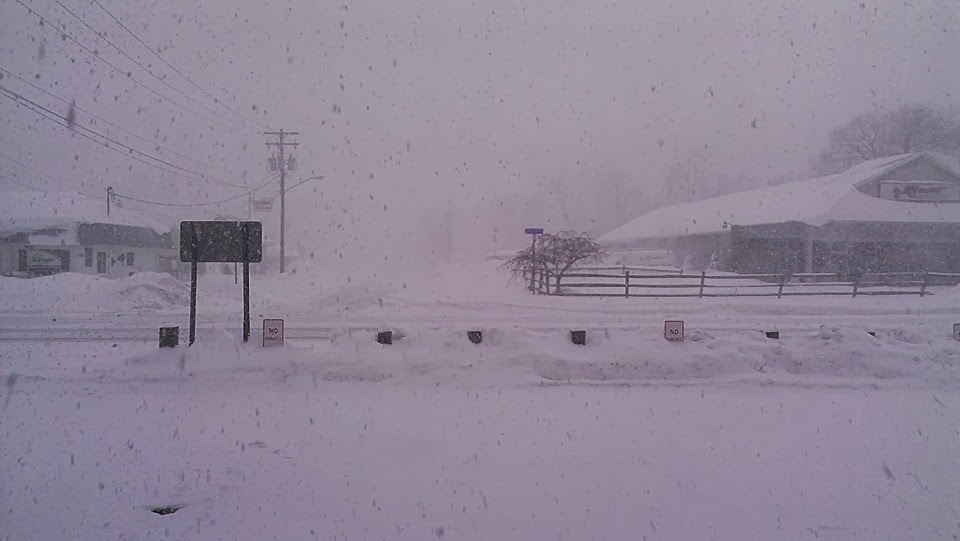
Snow Day in Dunkirk, NY: Photo by Morgan Burns
-Gardens
-Gardening
-Green Stuff
-More Gardening


AND...


How to (realistically) plan for your garden this year in the depths of winter?


Step 1: Figure out where you want to plant your garden if you don't have one already.  Think about how much sunlight your plants need, if water is accessible to your site, if the soil is full or rocks or clay, and if animals are likely to ransack it.  All these factors play into where you should plant your garden.

Porter Ave. Garden in Fredonia in 2013
Step 2: Plan your garden layout. Is it going to have raised beds or be tilled? Would you like to design a "pizza" garden or a traditional vegetable garden.  Also, think about which plants need shade and water more than others and which plants have symbiotic relationships.  For example, you don't want to plant a tall plant next to a short plants that needs a lot of sunlight.


Step 3: Think about what you're going to grow.  If you love parsnips and tomatoes, then plant parsnips and tomatoes!  If you love flowers, plant a border of flowers around the garden.  And think now about which plants must be started inside early as well as which plants can be sown directly into the ground.  It is as simple as that!

CCRM Kitchen Garden in 2013
Step 4: Make a goal to set aside a portion of your garden to grow food for the local soup kitchen and food pantry.  Soup kitchens all over the nation are always in need of fresh and healthy food.  You can help meet this demand by growing a little extra this year to donate to the impoverished and chronically under-nourished in your locality. 

Unfortunately, this is really all the planning you can do when the weather is -10 degrees Fahrenheit outside.  But think now about maybe joining a gardening group, or even starting one yourself! And maybe you live in an apartment or low income housing area where you can't grow a garden on the property:  Then check out community gardens around the area and see if they have room for one more.   :)


Thursday, January 2, 2014

This may not be the healthiest of all recipes, but it sure is perfect for the winter season! 


Fairbanks Maple Syrup-Peanut Butter Sauce


Photo by Betsy Dillbeck: The bucket method by Fairbanks.
Fairbanks Maple is a local producer or maple syrup along Lake Erie established over 50 years with about 12 miles of maple lines through the woods.  They make all things maple including maple coated nuts, maple chutney, maple candy, maple sauce, and of course, maple syrup.  This recipe is from a workshop they hosted last winter at the soup kitchen in Dunkirk.


Ingredients
  • 1 cup maple syrup
  • 1/2 cup creamy peanut butter

Directions
In a saucepan over low heat, warm up maple syrup.  Stir in peanut butter until combined and thoroughly warmed.  Use over ice cream or cake or as a fruit or veggie dip.  

Check out the workshop held by Fairbanks Maple at the Dunkirk Friendly Kitchen on youTube by following this link:
Fairbanks Maple Cooking Workshop